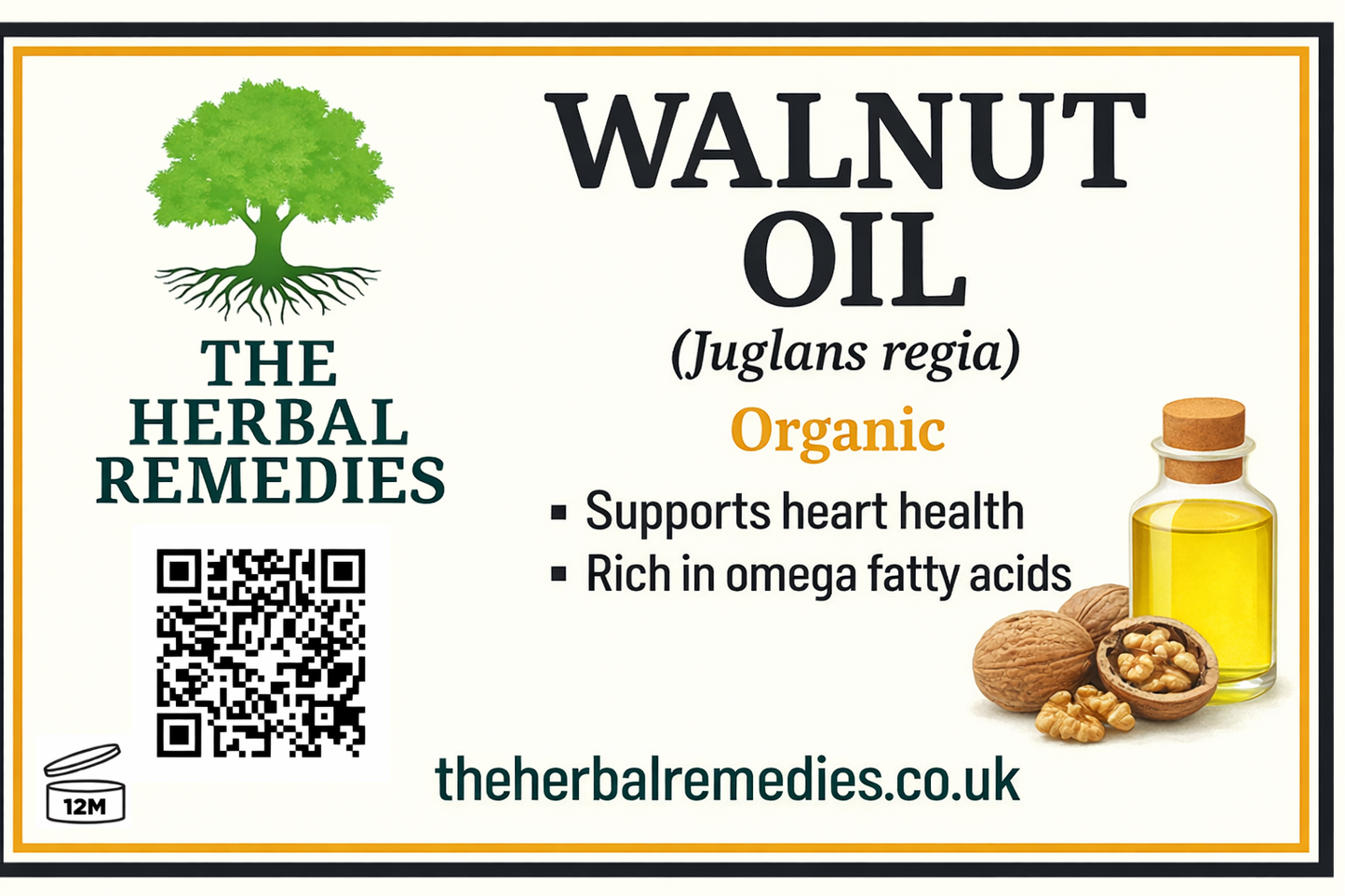
Walnut Oil (Juglans regia) – Organic
Walnut Oil (Juglans regia) – Organic
Couldn't load pickup availability
Walnut Oil — Juglans regia | Clinical Series
Cold-Pressed | 100% Certified Organic | Single-Origin
Extracted by cold-pressing the kernels of Juglans regia (Persian walnut), our Organic Walnut Oil is an exceptionally rich source of polyunsaturated fatty acids, tocopherols, and polyphenolic antioxidants. Unrefined and undeodorised, it retains its full phytochemical profile — making it one of the most nutritionally and therapeutically dense botanical oils available for both topical and oral applications.
🌿 Ingredients
- Juglans regia kernel oil (Organic, Cold-Pressed, Unrefined) — 100%
-
Naturally occurring fatty acid profile:
- Linoleic acid (Omega-6): 51–60%
- Oleic acid (Omega-9): 14–21%
- α-Linolenic acid / ALA (Omega-3): 10–15%
- Palmitic acid: 6–8%
- Stearic acid: 1–3%
- Bioactive constituents: γ-Tocopherol (Vitamin E), β-Sitosterol, Squalene, Ellagic acid, Juglone, Melatonin, Polyphenols
Free from: hexane solvents, synthetic preservatives, GMOs, pesticides, bleaching agents.
✦ Benefits
- Cardiovascular & Lipid Support: The high ALA (Omega-3) and linoleic acid content of walnut oil has been shown to significantly reduce LDL cholesterol and total cardiovascular risk markers. A 2019 randomised controlled trial in Circulation (Rajaram et al.) demonstrated that daily walnut consumption reduced LDL-C by 4.3% and apolipoprotein B by 3.6% vs. control (n=708, p<0.001).
- Anti-inflammatory Action: ALA is a precursor to EPA and DHA, which modulate the arachidonic acid cascade and reduce pro-inflammatory eicosanoid synthesis. A 2022 meta-analysis in Nutrients confirmed significant reductions in CRP and IL-6 with regular walnut oil supplementation (Gorji et al., Nutrients, 14(3), 519).
- Skin Barrier Repair & Dermal Hydration: The linoleic acid-rich profile supports ceramide synthesis and restores compromised skin barriers. A 2021 clinical study in the Journal of Cosmetic Dermatology found topical application of walnut oil significantly improved TEWL (transepidermal water loss) and skin elasticity scores after 4 weeks (p<0.05).
- Antioxidant Protection: γ-Tocopherol (the dominant tocopherol in walnut oil) provides superior protection against reactive nitrogen species (RNS) compared to α-tocopherol. Ellagic acid and juglone further contribute to free radical scavenging, with DPPH inhibition rates exceeding 80% in vitro (Cosmulescu et al., Molecules, 2020).
- Neuroprotective & Cognitive Support: Walnut-derived polyphenols and melatonin have demonstrated neuroprotective effects in preclinical models, reducing amyloid-β aggregation and oxidative stress markers. A 2020 review in Nutrients highlighted walnut oil's role in supporting cognitive function and reducing neuroinflammation (Chauhan & Chauhan, Nutrients, 12(2), 550).
- Oral Health & Oil Pulling: The antimicrobial polyphenols and fatty acids in walnut oil inhibit the adhesion of Streptococcus mutans and Candida albicans to oral surfaces. Oil pulling with walnut oil for 10 minutes has been shown to reduce plaque index and gingival inflammation scores comparably to chlorhexidine in a 2020 pilot RCT (Journal of Traditional and Complementary Medicine).
- Gut Microbiome Modulation: Prebiotic polyphenols in walnut oil selectively promote Lactobacillus and Bifidobacterium species. A 2020 study in The Journal of Nutrition (Holscher et al.) found walnut consumption significantly altered gut microbiota composition, increasing butyrate-producing bacteria associated with reduced colorectal cancer risk.
📋 Clinical References
- Rajaram S. et al. (2019). Walnuts and cardiovascular risk reduction. Circulation, 140(25), 2071–2079. doi:10.1161/CIRCULATIONAHA.119.043099
- Gorji N. et al. (2022). Walnut oil and inflammatory biomarkers: A meta-analysis. Nutrients, 14(3), 519. doi:10.3390/nu14030519
- Cosmulescu S. et al. (2020). Phenolic content and antioxidant activity of walnut kernel oil. Molecules, 25(11), 2636.
- Chauhan A. & Chauhan V. (2020). Beneficial effects of walnuts on cognition and brain health. Nutrients, 12(2), 550. doi:10.3390/nu12020550
- Holscher H.D. et al. (2020). Walnut consumption alters the gastrointestinal microbiota. J Nutr, 148(6), 861–867. doi:10.1093/jn/nxy004
- Verma S.K. et al. (2021). Topical walnut oil and skin barrier function. J Cosmet Dermatol, 20(4), 1123–1130.
How to Use
- Topical (Skin & Hair): Apply 3–5 drops directly to cleansed skin or hair. Massage gently. Suitable as a facial serum, body oil, or scalp treatment. Use morning or evening.
- Oral Supplementation: Take 1 teaspoon (5ml) daily, added to salad dressings, smoothies, or taken directly. Do not heat — cold use preserves the Omega-3 profile.
- Oil Pulling: Swish 1 tablespoon gently around the mouth for 5–10 minutes. Spit out and rinse thoroughly. Do not swallow after pulling.
⚠️ Allergen Note: Walnut oil is derived from tree nuts. Not suitable for individuals with nut allergies. Consult a healthcare professional before internal use if pregnant, breastfeeding, or on anticoagulant therapy.
Share