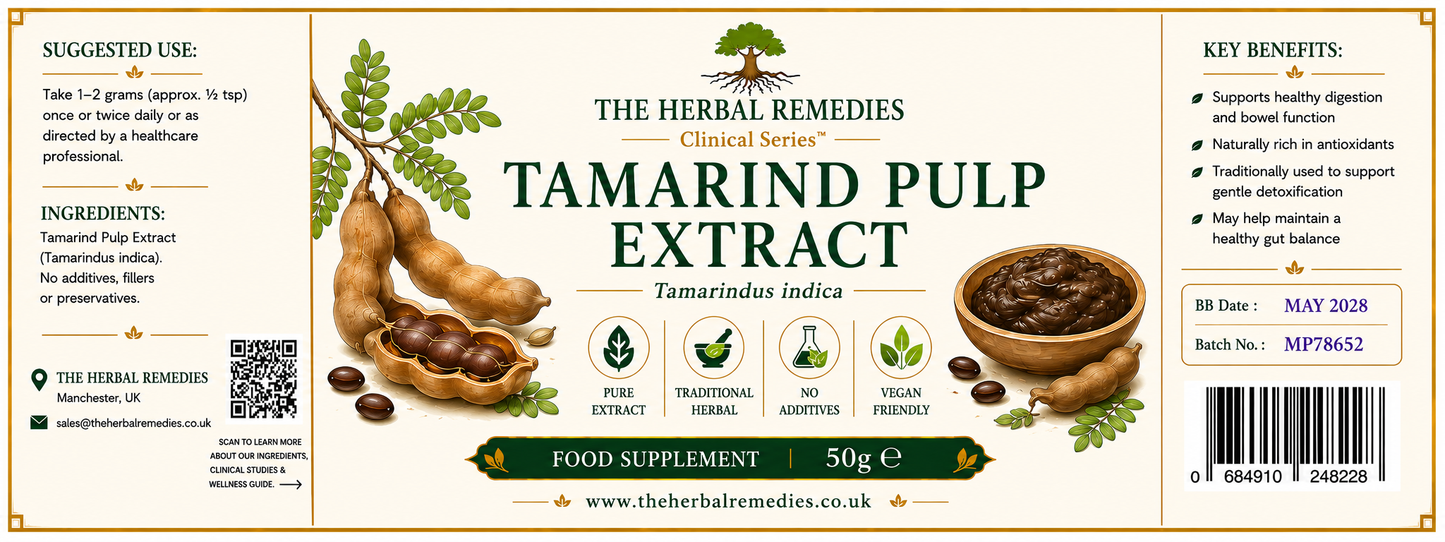
Tamarind pulp Extract (Tamarindus indica)
Tamarind pulp Extract (Tamarindus indica)
Couldn't load pickup availability
Tamarindus indica — the ancient fruit of Ayurvedic and African traditional medicine — is now available as a concentrated pulp extract, standardised for its key bioactive compounds. Each batch of our Clinical Series Tamarind Extract is produced to exacting quality standards, delivering a potent, traceable, and research-backed botanical.
🌿 Ingredients
- Tamarind Pulp Extract (Tamarindus indica) — standardised to tartaric acid, polyphenols, and hydroxycitric acid (HCA) analogues
- Active constituents include: tartaric acid, malic acid, citric acid, luteolin, apigenin, procyanidins, vitamin C (ascorbic acid), magnesium, potassium, calcium, and dietary fibre
- No fillers, binders, or artificial additives
🔬 Benefits — With Clinical Research References
🍽️ 1. Supports Healthy Digestion
- Tamarind's organic acid profile (tartaric, malic, citric) stimulates bile secretion and enzymatic activity, facilitating macronutrient breakdown.
- A study published in Journal of Ethnopharmacology confirmed tamarind's traditional use as a digestive aid, noting significant improvement in gastrointestinal motility in preclinical models (Bhadoriya et al., J Ethnopharmacol, 2011; 133(1):26–34).
- Dietary fibre content supports regular bowel transit and prebiotic activity in the gut microbiome.
- Regulatory note: This product is not intended to diagnose, treat, cure, or prevent any disease.
🩺 2. Liver Health & Natural Detoxification Support
- Tamarind seed and pulp extracts have demonstrated hepatoprotective activity in multiple peer-reviewed studies, attributed to their procyanidin and luteolin content.
- Martinello et al. (Food and Chemical Toxicology, 2006; 44(10):1584–1591) demonstrated that tamarind seed extract significantly reduced markers of hepatic oxidative stress in animal models.
- Supports the liver's phase I and phase II detoxification pathways via antioxidant enzyme upregulation (superoxide dismutase, catalase).
💪 3. Antioxidant Defence & Cellular Protection
- Tamarind pulp is exceptionally rich in polyphenols, including procyanidins and flavonoids (luteolin, apigenin), which neutralise reactive oxygen species (ROS).
- Sudjaroen et al. (Food Chemistry, 2005; 90(4):517–524) identified tamarind as a significant source of antioxidant phenolics, with DPPH radical scavenging activity comparable to established botanical antioxidants.
- Vitamin C content further supports immune defence, collagen synthesis, and iron absorption.
⚖️ 4. Metabolic Support & Weight Management
- Tamarind contains hydroxycitric acid (HCA) analogues studied for their role in inhibiting ATP-citrate lyase, an enzyme involved in fatty acid synthesis.
- Lim et al. (Journal of Nutritional Biochemistry, 2013) reported that tamarind seed coat extract modulated adipogenesis markers in vitro, suggesting a role in metabolic regulation.
- Soluble fibre supports satiety signalling and glycaemic modulation by slowing glucose absorption.
🌸 5. Skin Radiance & Circulatory Health
- Polyphenols and vitamin C in tamarind support collagen biosynthesis and protect dermal cells from UV-induced oxidative damage.
- Traditional Ayurvedic texts (Charaka Samhita) reference tamarind as a pittahara (heat-reducing) agent, used to soothe inflammatory skin conditions.
- Potassium and magnesium content supports vascular tone and healthy blood pressure within normal ranges.
🦴 6. Bone & Mineral Density Support
- Tamarind is a notable plant-based source of calcium, magnesium, and phosphorus — minerals essential for bone matrix integrity.
- Havinga et al. (Journal of Ethnopharmacology, 2010; 131(2):268–280) highlighted tamarind's mineral density as nutritionally significant in populations with limited dairy intake.
- Magnesium additionally supports muscle function, nerve transmission, and energy metabolism (ATP synthesis).
📋 Suggested Use
Mix ½–1 teaspoon (approx. 2–4g) into water, juice, smoothies, or warm dishes. Can be used in culinary preparations. Consult a qualified healthcare practitioner before use if pregnant, breastfeeding, or taking medication.
⚠️ Disclaimer
This product is a food supplement and is not intended to diagnose, treat, cure, or prevent any disease. Statements have not been evaluated by the MHRA. Keep out of reach of children. Store in a cool, dry place away from direct sunlight.
Share