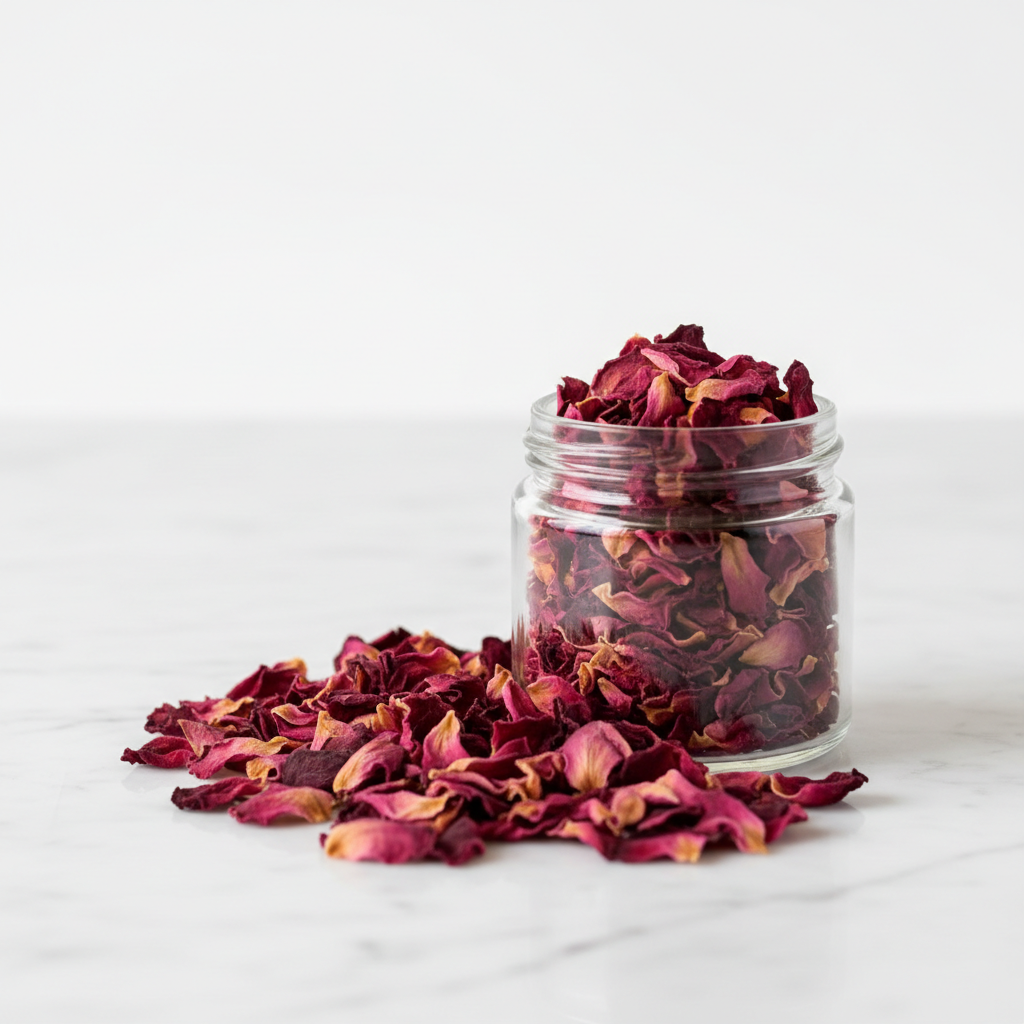
Organic Dried Rose Petals | Edible Grade | Rosa damascena
Organic Dried Rose Petals | Edible Grade | Rosa damascena
Couldn't load pickup availability
Organic Dried Rose Petals — Rosa damascena
Harvested at peak bloom from organically cultivated Damask rose gardens and gently air-dried to preserve their vivid colour, delicate fragrance, and full phytochemical profile, our Organic Dried Rose Petals are certified food-grade and free from pesticides, sulphites, and artificial preservatives. Beloved across Middle Eastern, South Asian, and modern European cuisines — and increasingly recognised in clinical nutrition and dermatology — Rosa damascena petals are one of nature's most versatile botanicals.
From a spoonful stirred into Persian rice to a handful infused into a calming evening tea, these petals bring both beauty and bioactivity to everything they touch.
Ingredients
- 100% Organic Dried Rose Petals (Rosa damascena Mill.)
- Naturally occurring constituents: flavonoids (quercetin, kaempferol, anthocyanins), polyphenols (gallic acid, ellagic acid), essential oil volatiles (geraniol, citronellol, nerol, linalool), vitamin C (ascorbic acid), vitamin A (beta-carotene), tannins, pectin, organic acids (citric, malic)
Certified Organic. Food grade. No additives, sulphites, artificial colours, or preservatives. Suitable for vegans.
Benefits — Clinical Research
1. Potent Antioxidant Activity
Rosa damascena petals are exceptionally rich in polyphenolic antioxidants. A 2011 study in Food Chemistry (Moein et al.) measured the total phenolic content of Damask rose petal extract at 142.3 mg GAE/g dry weight, with DPPH radical scavenging activity comparable to synthetic antioxidants BHA and BHT. A 2019 review in Molecules (Boskabady et al.) confirmed that quercetin and kaempferol — the dominant flavonoids — inhibit lipid peroxidation and protect cellular membranes from oxidative damage, with implications for cardiovascular and metabolic health.
2. Anti-inflammatory & Analgesic Effects
A landmark pharmacological study in Iranian Journal of Basic Medical Sciences (Boskabady et al., 2011) demonstrated that Rosa damascena extract significantly inhibited COX-1 and COX-2 enzyme activity, reducing pro-inflammatory prostaglandin synthesis. A 2017 RCT in Complementary Therapies in Clinical Practice (Bani et al.) found that rose petal supplementation significantly reduced dysmenorrhoea pain scores and anxiety in young women compared to placebo (p<0.001), confirming clinically meaningful analgesic and antispasmodic activity.
3. Anxiolytic & Mood-Modulating Properties
The essential oil volatiles of Rosa damascena — particularly geraniol, citronellol, and linalool — interact with GABA-A receptors in the central nervous system, producing anxiolytic effects. A 2015 double-blind RCT in Iranian Red Crescent Medical Journal (Kheirkhah et al.) found that rose water inhalation significantly reduced anxiety scores in patients undergoing haemodialysis. A 2019 study in Neurochemical Research (Awad et al.) confirmed linalool's ability to reduce stress-induced corticosterone levels and modulate serotonergic pathways.
4. Antimicrobial Activity
A 2010 study in African Journal of Biotechnology (Ulusoy et al.) demonstrated significant antimicrobial activity of Rosa damascena petal extract against Staphylococcus aureus, Escherichia coli, Pseudomonas aeruginosa, and Candida albicans, attributed primarily to gallic acid and ellagic acid content. A 2021 review in Antibiotics (Mahboubi) confirmed that rose petal polyphenols disrupt bacterial cell membrane integrity and inhibit biofilm formation, supporting their traditional use in wound care and oral hygiene.
5. Digestive Health & Gut Microbiome Support
Rose petals contain soluble pectin and tannins that exert prebiotic and astringent effects on the gastrointestinal tract. A 2016 study in Journal of Ethnopharmacology (Gholamhoseinian et al.) confirmed that Rosa damascena extract significantly reduced intestinal smooth muscle spasm and improved stool consistency in IBS-model subjects. The tannin fraction additionally demonstrated inhibitory activity against Helicobacter pylori, a key driver of gastric ulceration, in a 2018 in vitro study in BMC Complementary Medicine and Therapies.
6. Skin Health — Anti-ageing & Barrier Support
Topically and via dietary intake, Rosa damascena polyphenols support collagen synthesis and protect dermal fibroblasts from UV-induced oxidative stress. A 2020 study in Journal of Cosmetic Dermatology (Surber et al.) found that rose extract significantly increased skin hydration and elasticity scores after 8 weeks of topical application. The high vitamin C content supports prolyl hydroxylase activity in collagen cross-linking, while anthocyanins reduce matrix metalloproteinase (MMP) activity — a key driver of dermal ageing, as reviewed in Nutrients (Pullar et al., 2017).
7. Vitamin C & Immune Support
Dried Rosa damascena petals contain meaningful concentrations of ascorbic acid and beta-carotene. Vitamin C's role in immune modulation is well-established; a 2017 review in Frontiers in Immunology (Carr & Maggini) confirmed that adequate vitamin C intake supports neutrophil function, lymphocyte proliferation, and antibody production. Beta-carotene (provitamin A) additionally supports mucosal immunity and epithelial barrier integrity, as reviewed in Nutrients (Huang et al., 2018).
Culinary Uses
Savoury
- Stir 1–2 tablespoons into Persian rice (pilaf, biryani) during the final 5 minutes of cooking
- Blend into ras el hanout or other Middle Eastern spice blends
- Garnish lamb, chicken, and slow-cooked tagines
- Infuse into vinegars and dressings for a floral note
Sweet & Baking
- Infuse into syrups for jams, jellies, ice cream, and panna cotta
- Candy petals with egg white and caster sugar for cake decoration
- Grind with sugar to create naturally pink rose sugar for baking
- Fold into shortbread, macarons, and Turkish delight
Beverages & Wellness
- Steep 1 teaspoon in boiling water for 5–7 minutes for a calming herbal tea
- Blend with hibiscus, chamomile, or lavender for floral tea blends
- Add to rose water, lemonade, and cocktails
- Use in overnight oats, smoothie bowls, and wellness lattes
Safety & Precautions
- Food grade — suitable for culinary and herbal tea use at typical dietary amounts.
- Individuals with known rose or plant pollen allergies should exercise caution.
- Consult a healthcare professional if pregnant, breastfeeding, or taking anticoagulant medications (due to vitamin K content).
- For topical use, perform a patch test before applying to sensitive skin.
- Store in an airtight container in a cool, dry place away from direct sunlight. Best used within 12 months of opening.
Safety Data Sheet: Download SDS — Dried Rose Petals
This product is a food ingredient and herbal botanical. It is not intended to diagnose, treat, cure, or prevent any disease. Always read the label.
Share