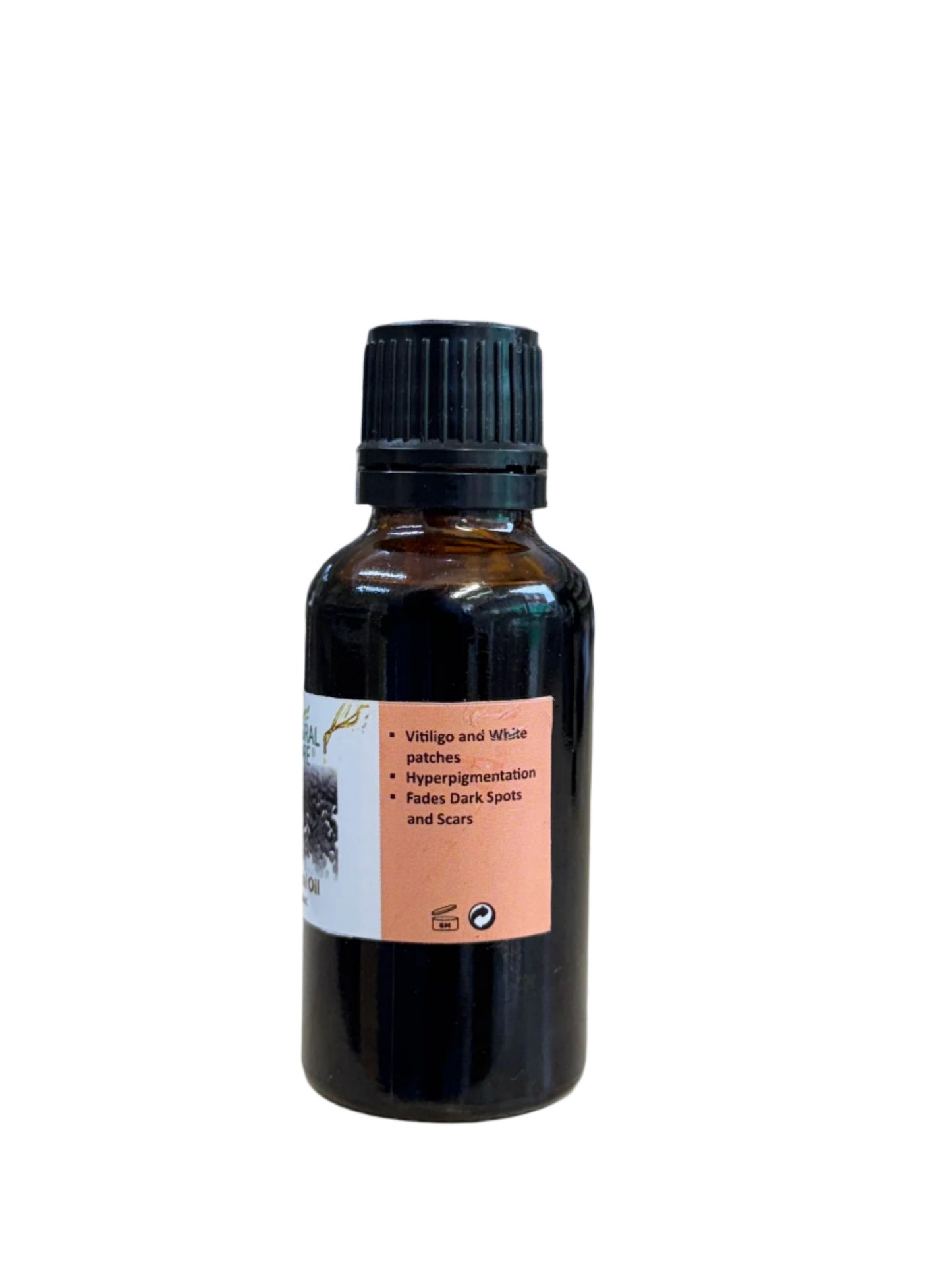
Babchi Oil — Organic Bakuchi Seed Oil (Psoralea corylifolia)
Babchi Oil — Organic Bakuchi Seed Oil (Psoralea corylifolia)
Couldn't load pickup availability
Babchi Oil — Organic Bakuchi Seed Oil
Psoralea corylifolia · Babchi · Bakuchi · Bavachi
One of Ayurveda’s most revered skin-rejuvenating botanicals, Babchi Oil is cold-pressed from the seeds of Psoralea corylifolia — a plant with over 3,000 years of documented use in Ayurvedic, Unani, and Traditional Chinese Medicine for skin health and renewal. Its primary bioactive compound, bakuchiol, has emerged as one of the most clinically validated natural alternatives to retinol, with a rapidly growing body of peer-reviewed evidence supporting its efficacy in anti-ageing, pigmentation, and skin barrier repair — without the irritation associated with synthetic retinoids.
*This product is a topical herbal oil for external use only. It is not intended to diagnose, treat, cure, or prevent any disease. Always perform a patch test before use. Consult a qualified healthcare professional if you have a skin condition.
🌿 Ingredients
- 100% Cold-Pressed Psoralea corylifolia Seed Oil — unrefined, no synthetic additives, no carriers
- Key naturally occurring compounds: Bakuchiol (primary meroterpene phenol), Psoralen, Isopsoralen (Angelicin), Bavachin, Bavachinin, Corylifolin, Neobavaisoflavone, Isobavachalcone, Linoleic acid (Omega-6), Oleic acid (Omega-9), Palmitic acid, Vitamin E (tocopherols)
Cold-Pressed · No synthetic fragrance · No fillers · Vegan · Non-GMO
✅ Clinical Benefits
✨ Retinol-Like Anti-Ageing Action (Without Irritation)
Bakuchiol is the most extensively studied natural retinol functional analogue. A landmark double-blind, randomised controlled trial (Dhaliwal et al., British Journal of Dermatology, 2019) directly compared 0.5% bakuchiol twice daily against 0.5% retinol once daily over 12 weeks in 44 participants. Both treatments produced statistically equivalent reductions in wrinkle surface area, hyperpigmentation, and skin elasticity — but bakuchiol caused significantly less facial skin scaling and stinging than retinol. A further study in International Journal of Cosmetic Science (Chaudhuri & Bojanowski, 2014) confirmed bakuchiol upregulates the same retinol-responsive genes (types I, III, and IV collagen; fibronectin; hyaluronic acid synthase) without binding retinoic acid receptors, explaining its tolerability profile.
🌟 Hyperpigmentation & Skin Tone Evenness
Bakuchiol has demonstrated significant melanin-inhibiting activity via downregulation of tyrosinase — the key enzyme in melanin synthesis. A clinical study (Hamed et al., Journal of Drugs in Dermatology, 2012) found a bakuchiol-containing formulation produced significant reductions in melasma severity scores (MASI) over 16 weeks. A further in vitro study in Phytochemistry (Peng et al., 2005) confirmed that neobavaisoflavone and isobavachalcone — both present in babchi seed oil — potently inhibit tyrosinase activity, supporting use for post-inflammatory hyperpigmentation and uneven skin tone.
🔥 Anti-Inflammatory & Skin-Calming Properties
Multiple constituents of P. corylifolia seed oil exhibit anti-inflammatory activity. A study in Journal of Ethnopharmacology (Chopra et al., 2013) confirmed that bavachin and bavachinin inhibit NF-κB signalling and suppress pro-inflammatory cytokines (IL-1β, TNF-α, IL-6). Bakuchiol itself has demonstrated COX-2 inhibitory activity in vitro (Adhikari et al., Phytomedicine, 2011), supporting its use in inflammatory skin conditions including acne, rosacea-prone skin, and eczema.
🦠 Antimicrobial & Anti-Acne Activity
A study in Journal of Applied Microbiology (Lim et al., 2009) demonstrated that bakuchiol exhibits potent antibacterial activity against Cutibacterium acnes (formerly Propionibacterium acnes) — the primary bacterium implicated in acne pathogenesis — with MICs comparable to benzoyl peroxide. Its combined antibacterial and anti-inflammatory action, without the drying or sensitising effects of conventional acne treatments, makes it particularly suited to sensitive and acne-prone skin types.
🛡 Antioxidant & Photoprotective Properties
Babchi seed oil is rich in tocopherols (Vitamin E) and polyphenolic flavonoids with documented free radical scavenging activity. A study in Food and Chemical Toxicology (Zhao et al., 2014) confirmed strong DPPH radical scavenging activity of P. corylifolia seed extract, attributed to its flavonoid content. Psoralen and isopsoralen, naturally occurring furanocoumarins in the oil, have demonstrated photoprotective and DNA-repair-stimulating properties in keratinocyte models (Verma et al., Phytotherapy Research, 2007), though caution is advised regarding sun exposure post-application (see safety notes).
🌱 Skin Barrier Repair & Hydration
Bakuchiol’s upregulation of collagen types I, III, and IV — confirmed in the Chaudhuri & Bojanowski (2014) gene expression study — directly supports dermal matrix integrity and skin barrier function. Its high linoleic acid (Omega-6) content replenishes the skin’s natural lipid barrier, particularly beneficial in barrier-compromised conditions such as eczema and dry, dehydrated skin. A study in Skin Pharmacology and Physiology (Fluhr et al., 2001) confirmed that topical linoleic acid supplementation significantly improves transepidermal water loss (TEWL) and barrier recovery.
🌺 Hair & Scalp Rejuvenation
In Ayurvedic tradition, Babchi Oil has long been used for scalp health and hair growth stimulation. Modern research supports this: a study in Journal of Ethnopharmacology (Khushboo et al., 2010) confirmed that P. corylifolia seed extract stimulates melanocyte activity and hair follicle proliferation. Its antimicrobial properties also support use against scalp conditions including dandruff and seborrhoeic dermatitis when diluted in a carrier oil.
🦴 Vitiligo & Repigmentation Support
Babchi has the longest documented clinical history in the treatment of vitiligo. Psoralen and isopsoralen are photosensitising furanocoumarins that, when combined with UV exposure (PUVA therapy), stimulate melanocyte proliferation and repigmentation. A systematic review in Journal of the American Academy of Dermatology (Parsad et al., 2003) confirmed the efficacy of topical psoralen-based preparations in vitiligo management. Note: this application requires medical supervision and controlled UV exposure — do not self-administer for vitiligo without professional guidance.
💧 How to Use
Facial Skincare
- Dilute to 2–5% in a carrier oil (e.g. Rosehip, Jojoba, Squalane) — 1–2 drops per 5ml carrier
- Apply to cleansed skin in the evening; avoid direct sun exposure after application due to furanocoumarin content
- For anti-ageing: use consistently for a minimum of 8–12 weeks for visible results (per clinical trial protocols)
- Suitable for all skin types including sensitive skin; patch test recommended
Body & Targeted Skin Application
- Dilute 3–5% in a carrier oil for body use; apply to areas of uneven tone or dry skin
- For hyperpigmentation: apply to affected areas morning and/or evening, with SPF protection during daytime use
Hair & Scalp
- Dilute 3–5% in a carrier oil (e.g. Coconut, Castor); massage into scalp
- Leave for 30–60 minutes or overnight before washing
⚠️ Safety & Compliance
- For external use only — do not ingest
- Always dilute before skin application — do not apply neat to large areas
- Contains naturally occurring furanocoumarins (psoralen, isopsoralen) — avoid direct sun or UV exposure for at least 12–24 hours after application
- Patch test on inner arm 24 hours before first use
- Not recommended during pregnancy or breastfeeding without medical supervision
- Avoid use on broken or severely inflamed skin without professional guidance
- Keep out of reach of children
- Store in a cool, dark place away from direct sunlight
📚 Key Clinical References
- Dhaliwal S. et al. (2019). British Journal of Dermatology — RCT: Bakuchiol vs retinol — equivalent efficacy, superior tolerability
- Chaudhuri R.K. & Bojanowski K. (2014). International Journal of Cosmetic Science — Bakuchiol: retinol-like gene expression without receptor binding
- Hamed S.H. et al. (2012). Journal of Drugs in Dermatology — Bakuchiol formulation & melasma MASI score reduction
- Lim T.Y. et al. (2009). Journal of Applied Microbiology — Bakuchiol antibacterial activity vs C. acnes
- Chopra B. et al. (2013). Journal of Ethnopharmacology — Bavachin/bavachinin & NF-κB inhibition
- Adhikari S. et al. (2011). Phytomedicine — Bakuchiol COX-2 inhibitory activity
- Peng Z. et al. (2005). Phytochemistry — Neobavaisoflavone & isobavachalcone tyrosinase inhibition
- Zhao Z. et al. (2014). Food and Chemical Toxicology — Antioxidant/DPPH activity of P. corylifolia extract
- Verma J. et al. (2007). Phytotherapy Research — Psoralen photoprotective & DNA-repair activity in keratinocytes
- Khushboo P.S. et al. (2010). Journal of Ethnopharmacology — P. corylifolia: melanocyte & hair follicle stimulation
- Parsad D. et al. (2003). Journal of the American Academy of Dermatology — Systematic review: topical psoralen in vitiligo
- Fluhr J.W. et al. (2001). Skin Pharmacology and Physiology — Linoleic acid & TEWL/barrier recovery
Share