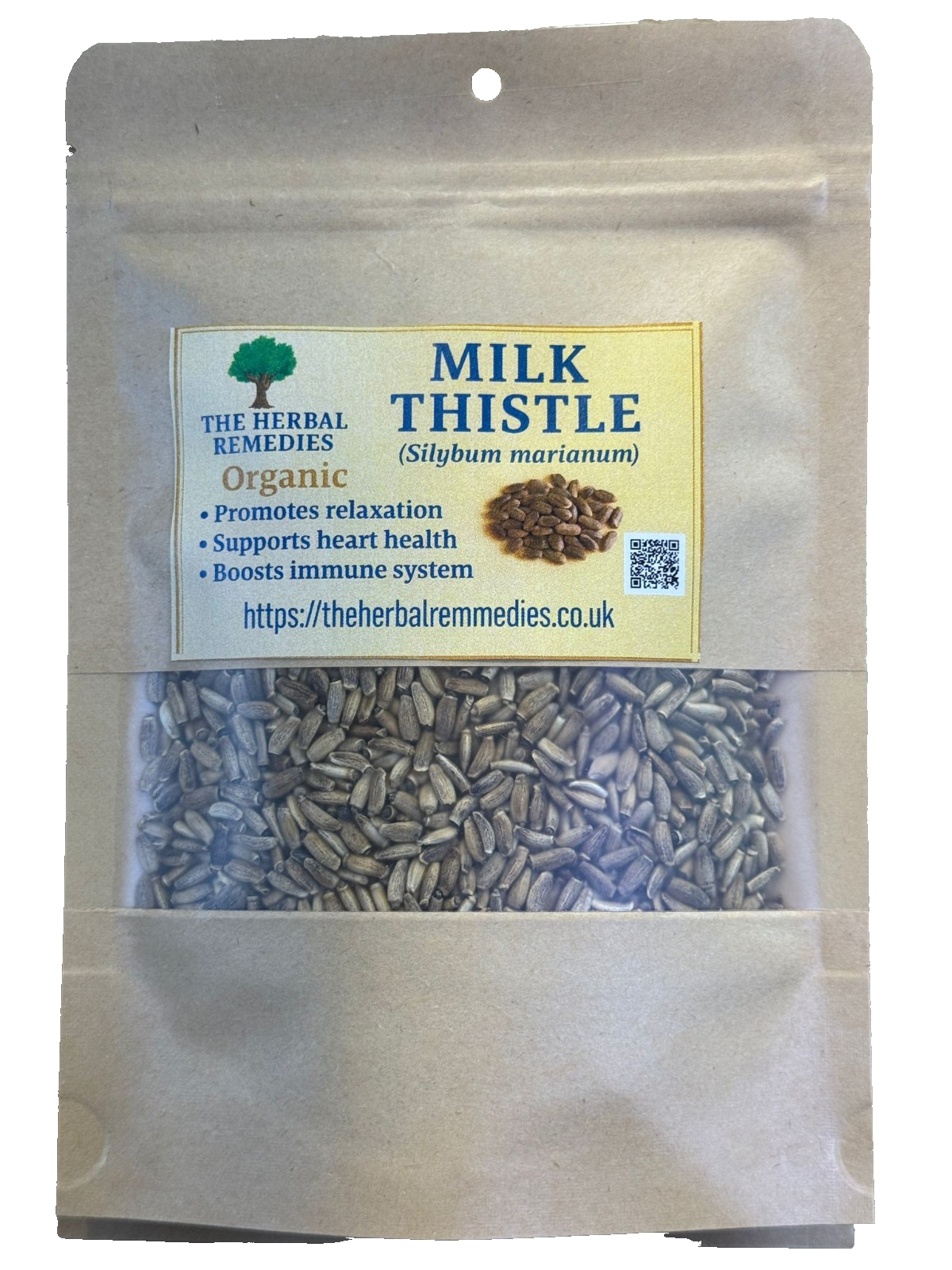
Milk Thistle Seeds — Silybum marianum (Whole) | 50g & 100g
Milk Thistle Seeds — Silybum marianum (Whole) | 50g & 100g
Couldn't load pickup availability
Milk Thistle Seeds — Silybum marianum (Whole)
Hepatoprotective | Antioxidant | Anti-inflammatory | Hormonal Support | Antidiabetic
Milk Thistle (Silybum marianum) is one of the most extensively researched medicinal plants in modern phytopharmacology, with over 1,000 peer-reviewed studies published to date. Native to the Mediterranean and naturalised across Europe, Asia, and the Americas, its seeds contain the highest concentration of silymarin — a complex of flavonolignans that constitutes the plant’s primary bioactive fraction. Silymarin comprises silybin (silibinin) A & B, silydianin, silychristin, and isosilybin, with silybin accounting for approximately 50–70% of total silymarin content and representing the most pharmacologically active constituent.
Available as whole seeds in 50g and 100g. Whole seeds retain maximum potency and can be ground fresh for teas, tinctures, or culinary use.
Active Constituents
- Silymarin Complex (Flavonolignans) — The principal bioactive fraction, comprising silybin A & B, isosilybin A & B, silychristin, silydianin, and taxifolin. Concentrated in the seed pericarp at 1.5–3% by dry weight. Exhibits hepatoprotective, antioxidant, anti-inflammatory, and antifibrotic activity.
- Silybin (Silibinin) — The most abundant and bioactive flavonolignan. Inhibits hepatotoxin uptake into hepatocytes, stimulates ribosomal RNA synthesis, and promotes hepatocyte regeneration. Also studied for anticancer and antidiabetic properties.
- Fatty Acids — Seeds contain 20–30% fixed oil, rich in linoleic acid (omega-6, ~60%), oleic acid (omega-9, ~30%), and palmitic acid. Supports lipid metabolism and cardiovascular health.
- Tocopherols (Vitamin E) — Natural antioxidants present in the seed oil fraction, contributing to membrane protection and anti-inflammatory activity.
- Phytosterols — Including β-sitosterol, which supports cholesterol regulation and prostate health.
- Proteins & Amino Acids — Seeds contain approximately 25–30% protein by dry weight, including essential amino acids, contributing to nutritional value.
- Flavonoids & Polyphenols — Including quercetin and kaempferol derivatives, contributing to systemic antioxidant and anti-inflammatory activity.
Benefits & Clinical Research
1. Hepatoprotection — Liver Defence & Regeneration
Milk thistle’s hepatoprotective action is its most robustly evidenced benefit. Silybin competitively inhibits the binding of hepatotoxins (including Amanita phalloides toxins, alcohol metabolites, and pharmaceutical hepatotoxins) to hepatocyte membrane receptors, preventing cellular uptake. A landmark meta-analysis published in the American Journal of Gastroenterology (Saller et al., 2008) reviewed 13 RCTs and concluded that silymarin significantly reduced liver enzyme levels (ALT, AST) in patients with alcoholic liver disease, viral hepatitis, and drug-induced liver injury. A more recent systematic review in Phytomedicine (Gillessen & Schmidt, 2020) confirmed silymarin’s efficacy in non-alcoholic fatty liver disease (NAFLD), demonstrating significant reductions in hepatic steatosis and fibrosis markers over 6–12 months of supplementation.
2. Antioxidant Activity — Free Radical Scavenging
Silymarin is a potent direct antioxidant and indirect inducer of endogenous antioxidant enzymes. It upregulates superoxide dismutase (SOD), catalase, and glutathione peroxidase — the body’s primary intracellular antioxidant defence system. A study in Free Radical Biology and Medicine (Valenzuela & Garrido, 1994) demonstrated that silybin’s antioxidant potency exceeds that of vitamin E in lipid peroxidation models. More recently, a clinical trial published in Oxidative Medicine and Cellular Longevity (Loguercio et al., 2012) confirmed significant increases in plasma glutathione and reductions in malondialdehyde (a lipid peroxidation marker) in patients supplementing with silymarin over 12 weeks.
3. Anti-inflammatory Action
Silymarin inhibits the NF-κB signalling pathway — a master regulator of inflammatory gene expression — and suppresses pro-inflammatory cytokines including TNF-α, IL-1β, IL-6, and COX-2-mediated prostaglandin synthesis. A study in the Journal of Hepatology (Manna et al., 1999) demonstrated that silybin inhibited NF-κB activation in human hepatocytes at physiologically relevant concentrations. This systemic anti-inflammatory activity extends beyond the liver, with implications for inflammatory bowel conditions, skin inflammation, and metabolic syndrome.
4. Blood Glucose Regulation & Antidiabetic Effects
Silymarin has demonstrated significant antidiabetic activity in both preclinical and clinical settings. A double-blind RCT published in Phytotherapy Research (Huseini et al., 2006) found that silymarin supplementation (200mg three times daily) significantly reduced fasting blood glucose, HbA1c, total cholesterol, LDL, and triglycerides in type 2 diabetic patients over 4 months compared to placebo. A 2020 meta-analysis in Complementary Therapies in Medicine (Voroneanu et al., 2020) pooled data from 9 RCTs and confirmed significant reductions in fasting glucose and insulin resistance indices (HOMA-IR) with silymarin supplementation.
5. Cholesterol & Cardiovascular Support
The phytosterol fraction (particularly β-sitosterol) and silymarin’s lipid-regulating properties contribute to cardiovascular health. Clinical studies have documented reductions in total cholesterol, LDL cholesterol, and triglycerides alongside increases in HDL cholesterol. A study in the European Journal of Clinical Pharmacology (Skottová & Krecman, 1998) demonstrated that silymarin significantly reduced LDL oxidation — a key step in atherosclerotic plaque formation — in animal models, with subsequent human studies supporting lipid-lowering effects in metabolic syndrome patients.
6. Hormonal & Oestrogenic Activity
Silychristin, a constituent of the silymarin complex, has been identified as a phytoestrogen with selective oestrogen receptor modulator (SERM) activity. Research published in the Journal of Steroid Biochemistry and Molecular Biology (Seidlová-Wuttke et al., 2003) demonstrated that silymarin exerted oestrogenic effects on bone density and lipid profiles in ovariectomised rat models without stimulating uterine tissue, suggesting a favourable SERM profile. This supports traditional use of milk thistle in supporting hormonal balance and menopausal symptoms.
7. Anticancer & Antiproliferative Potential
Silybin has been extensively investigated as an adjunct in oncology. It inhibits cancer cell proliferation via multiple mechanisms: cell cycle arrest at G1/S and G2/M phases, induction of apoptosis via caspase activation, inhibition of EGFR and STAT3 signalling, and anti-angiogenic activity. A clinical pilot study published in Cancer Chemotherapy and Pharmacology (Flaig et al., 2007) demonstrated that oral silybin-phosphatidylcholine complex achieved measurable plasma concentrations in prostate cancer patients and was associated with reductions in PSA velocity. A comprehensive review in Integrative Cancer Therapies (Deep & Agarwal, 2010) summarised preclinical evidence across breast, prostate, colorectal, and bladder cancer models. These findings are preliminary and do not constitute clinical evidence of anticancer efficacy.
8. Skin Health & Photoprotection
Topical and systemic silymarin has demonstrated significant photoprotective and anti-ageing properties. A study in Photochemistry and Photobiology (Katiyar et al., 1997) showed that topical silymarin application significantly reduced UV-B-induced skin damage, oxidative stress, and inflammatory responses in murine models. More recent research in Skin Pharmacology and Physiology (Becker et al., 2014) confirmed silymarin’s ability to inhibit matrix metalloproteinases (MMPs) responsible for collagen degradation, supporting its use in anti-ageing formulations.
Traditional & Culinary Uses
- Ground seeds brewed as a herbal tea or decoction for liver support
- Seeds added to smoothies, porridge, or yoghurt as a nutritional supplement
- Cold-pressed seed oil used as a culinary and topical oil
- Traditional European folk medicine for gallbladder complaints, jaundice, and liver congestion
- Unani medicine: used as a hepatic tonic and digestive bitter
How to Use
- Tea/Decoction: Lightly crush 1 teaspoon of whole seeds and simmer in 250ml water for 10–15 minutes. Strain and drink 1–3 cups daily.
- Ground powder: Grind seeds in a coffee or spice grinder. Add 1 teaspoon to smoothies, cereals, or yoghurt daily.
- Tincture: Macerate crushed seeds in food-grade alcohol (40–60%) for 4–6 weeks. Take 2–4ml in water, 2–3 times daily.
Precautions
- Generally well-tolerated. Mild laxative effect may occur at high doses due to bile-stimulating activity.
- Consult a healthcare professional if pregnant, breastfeeding, or taking hepatically-metabolised medications (silymarin may inhibit CYP3A4 and CYP2C9 enzymes).
- Those with ragweed or Asteraceae family allergies should exercise caution.
- Store in a cool, dry place away from direct sunlight. Keep out of reach of children.
Sold as a whole botanical seed for herbal, culinary, and nutritional use. These statements have not been evaluated by the MHRA. This product is not intended to diagnose, treat, cure, or prevent any disease. Always consult a qualified healthcare professional before use as a therapeutic supplement.
Share