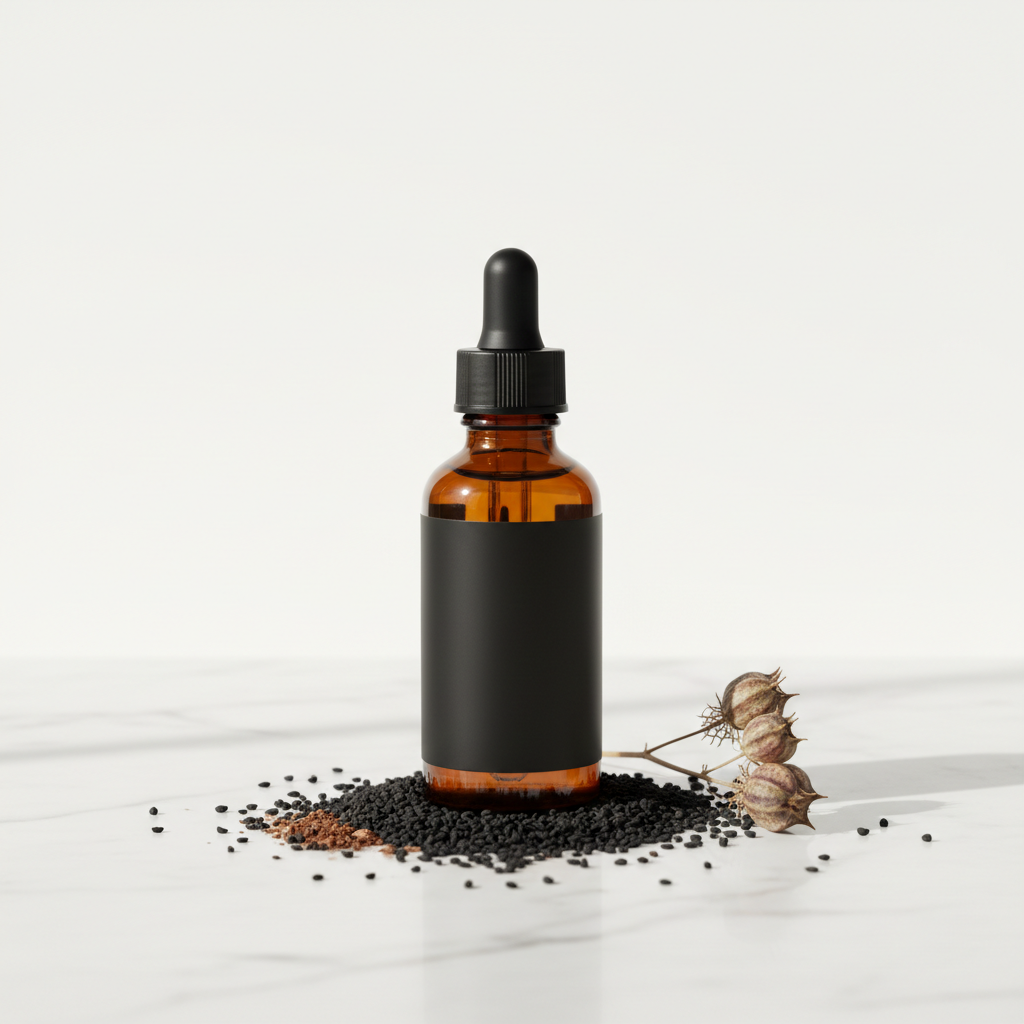
Black Seed Oil — Premium Cold-Pressed Oil (Nigella sativa / Black Cumin Seed Oil) (Copy)
Black Seed Oil — Premium Cold-Pressed Oil (Nigella sativa / Black Cumin Seed Oil) (Copy)
Couldn't load pickup availability
Black Seed Oil — Premium Cold-Pressed Oil
Nigella sativa · Black Cumin Seed Oil · Kalonji Oil
Revered for over 2,000 years across Ayurvedic, Unani, and Islamic traditional medicine, Black Seed Oil is one of the most extensively researched botanical oils in modern phytotherapy. Cold-pressed from the seeds of Nigella sativa, our oil preserves the full spectrum of bioactive compounds — most notably thymoquinone (TQ) — responsible for its wide-ranging therapeutic properties.
*This product is a food supplement. It is not intended to diagnose, treat, cure, or prevent any disease. Always consult a qualified healthcare professional before use.
🌿 Ingredients
- 100% Cold-Pressed Nigella sativa Seed Oil — unrefined, unfiltered, no additives, no carriers
- Key naturally occurring compounds: Thymoquinone (TQ), Thymohydroquinone (THQ), Thymol, Carvacrol, Nigellone, p-Cymene, α-Pinene, Linoleic acid (Omega-6), Oleic acid (Omega-9), Palmitic acid
No artificial preservatives · No fillers · Non-GMO · Suitable for vegans
✅ Clinical Benefits
🛡 Immune System Modulation
Thymoquinone has demonstrated immunomodulatory activity in multiple peer-reviewed studies. A 2021 review published in Phytomedicine (Tavakkoli et al.) confirmed TQ's ability to regulate both innate and adaptive immune responses, including upregulation of natural killer (NK) cell activity and T-lymphocyte proliferation. A randomised controlled trial (Salem et al., Journal of Ethnopharmacology, 2020) found significant improvements in immune markers in participants supplementing with N. sativa oil over 8 weeks.
🔥 Anti-Inflammatory Action
TQ inhibits the NF-κB signalling pathway — a central mediator of systemic inflammation — as demonstrated in a landmark study by Houghton et al. (Planta Medica, 1995) and subsequently confirmed in human trials. A 2019 meta-analysis in Phytotherapy Research (Sahebkar et al.) found statistically significant reductions in CRP (C-reactive protein) and IL-6 levels following N. sativa supplementation, supporting its use in inflammatory conditions including arthritis and metabolic syndrome.
🌬 Respiratory & Allergy Support
A double-blind, placebo-controlled trial (Gholamnezhad et al., Avicenna Journal of Phytomedicine, 2016) demonstrated that N. sativa supplementation significantly reduced asthma symptom scores and improved pulmonary function tests (FEV1) over 3 months. A further RCT (Nikakhlagh et al., American Journal of Otolaryngology, 2011) found black seed oil reduced nasal mucosal congestion and allergic rhinitis symptoms compared to placebo.
🍽 Digestive & Gut Health
Black seed oil has demonstrated gastroprotective effects in clinical settings. A study in Digestive Diseases and Sciences (Hashem-Dabaghian et al., 2012) found N. sativa significantly reduced symptoms of functional dyspepsia — including bloating, nausea, and epigastric pain — compared to placebo. Its carminative and antispasmodic properties are attributed to thymol and carvacrol content.
❤️ Cardiovascular & Metabolic Health
A systematic review and meta-analysis (Sahebkar et al., Journal of Hypertension, 2016) of 11 RCTs found N. sativa supplementation produced significant reductions in systolic and diastolic blood pressure. A separate meta-analysis (Journal of Diabetes & Metabolic Disorders, 2015) confirmed meaningful reductions in fasting blood glucose, total cholesterol, LDL-cholesterol, and triglycerides, with concurrent increases in HDL-cholesterol.
✨ Skin Health (Topical Use)
A randomised trial (Yousefi et al., Journal of Dermatology & Dermatologic Surgery, 2013) found topical N. sativa oil comparable to Betamethasone cream in reducing acne lesion counts and improving quality of life scores. Its antimicrobial activity against Staphylococcus aureus and anti-inflammatory TQ content support use in eczema, psoriasis, and barrier-compromised skin.
💇 Hair & Scalp Support
A 2014 study in Journal of Dermatology & Dermatologic Surgery (Akbar et al.) found topical application of N. sativa oil significantly reduced telogen effluvium (hair shedding) and improved hair density scores after 3 months. Its antifungal properties (active against Candida albicans and Malassezia) also support scalp health and dandruff reduction.
💊 Recommended Use
Internal (Adults)
- ½ to 1 teaspoon (2–5 ml) once or twice daily
- Best taken after meals; may be mixed with warm water, honey, or juice
- For sustained benefit, consistent daily use over 4–8 weeks is recommended based on clinical trial protocols
External
- Skin: Apply 3–5 drops to affected area once or twice daily; patch test first
- Hair & Scalp: Massage into scalp; leave for 30–60 minutes or overnight before washing
- Joint Massage: Apply gently to affected areas with circular motion
⚠️ Safety & Compliance
- Do not exceed the recommended daily intake
- Not recommended during pregnancy or breastfeeding without medical supervision
- Consult a healthcare professional if taking anticoagulant, antihypertensive, or antidiabetic medication
- Discontinue use if adverse reaction occurs
- Keep out of reach of children
- Store in a cool, dark place away from direct sunlight
📚 Key Clinical References
- Tavakkoli A. et al. (2021). Phytomedicine — Immunomodulatory effects of thymoquinone
- Sahebkar A. et al. (2016). Journal of Hypertension — Meta-analysis: N. sativa & blood pressure
- Sahebkar A. et al. (2015). Journal of Diabetes & Metabolic Disorders — Meta-analysis: lipid & glucose effects
- Gholamnezhad Z. et al. (2016). Avicenna Journal of Phytomedicine — RCT: asthma & pulmonary function
- Hashem-Dabaghian F. et al. (2012). Digestive Diseases and Sciences — Functional dyspepsia RCT
- Yousefi M. et al. (2013). Journal of Dermatology & Dermatologic Surgery — Acne RCT
- Nikakhlagh S. et al. (2011). American Journal of Otolaryngology — Allergic rhinitis RCT
- Houghton P.J. et al. (1995). Planta Medica — NF-κB inhibition by thymoquinone
Share