Baobab Extract | Premium Adansonia Fruit Powder
Baobab Extract | Premium Adansonia Fruit Powder
Couldn't load pickup availability
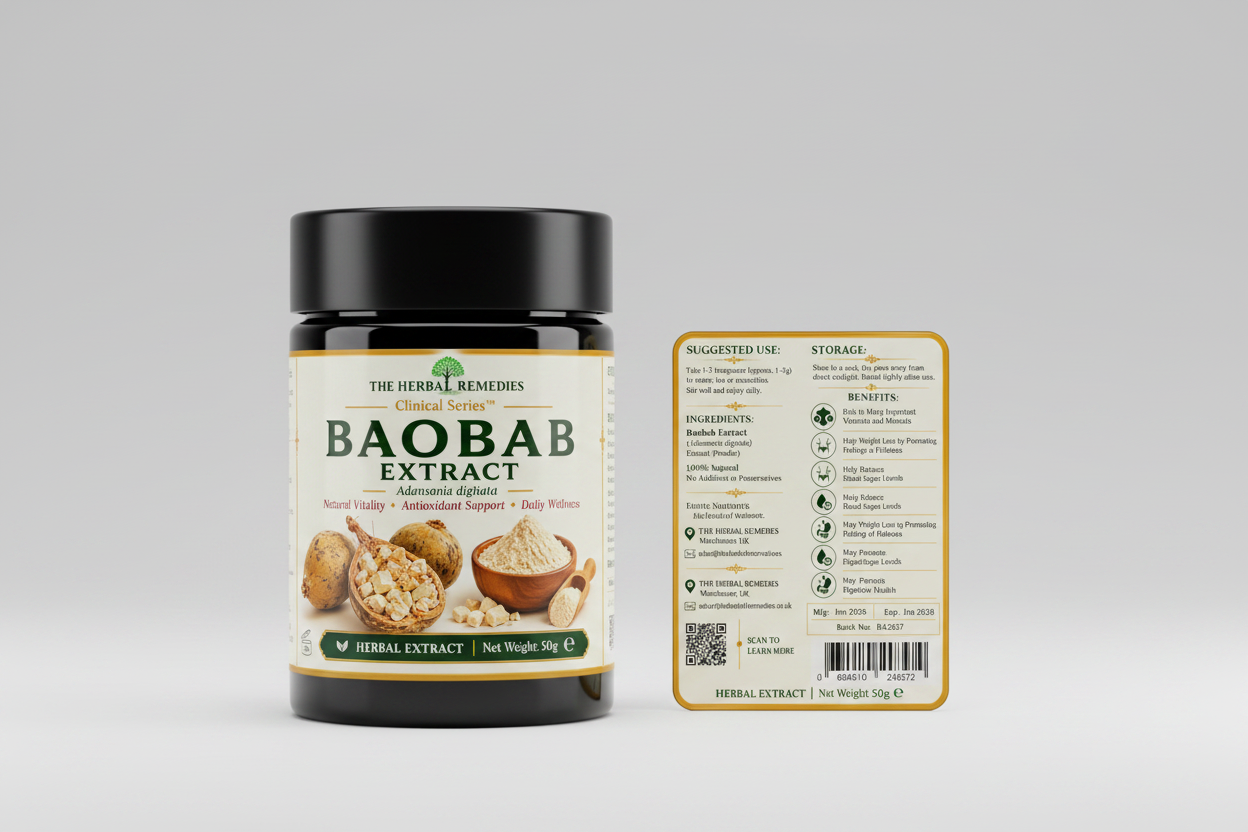
Baobab Extract — Adansonia digitata Fruit Powder
Sourced from the sun-dried fruit pulp, seeds, and leaves of the ancient African baobab tree (Adansonia digitata), our premium extract delivers one of nature's most concentrated sources of vitamin C, prebiotic fibre, and polyphenolic antioxidants. Cold-processed and standardised for nutritional consistency.
Ingredients
- Baobab Fruit Pulp Powder (Adansonia digitata) — 100% pure, no fillers, binders, or flow agents
- Naturally occurring: Vitamin C (ascorbic acid), dietary fibre (soluble & insoluble), calcium, magnesium, potassium, iron, zinc, B vitamins (B1, B2, B3, B6), polyphenols (flavonoids, tannins, procyanidins)
Free from: gluten, dairy, soy, artificial additives, GMO.
Benefits — Clinical Research
1. Exceptional Vitamin C Density & Immune Support
Baobab fruit pulp contains approximately 280–300 mg of vitamin C per 100 g — roughly six times the concentration found in fresh oranges. Vitamin C is a well-established immunomodulator; a 2013 meta-analysis in Nutrients (Hemilä & Chalker) confirmed that regular supplementation reduces the duration and severity of common cold episodes. A 2017 review in Frontiers in Immunology (Carr & Maggini) further demonstrated vitamin C's role in supporting both innate and adaptive immune responses, including neutrophil function and lymphocyte proliferation.
2. Prebiotic Fibre & Gut Microbiome Modulation
Baobab pulp is approximately 44–50% dietary fibre, with a favourable soluble-to-insoluble ratio. A randomised crossover study published in Nutrients (Tompkins et al., 2016) found that baobab fruit extract significantly increased populations of Bifidobacterium and Lactobacillus species in healthy adults, confirming prebiotic activity. A follow-up study (Tompkins et al., 2017, Nutrients) demonstrated that baobab extract attenuated the glycaemic response to white bread, reducing the incremental area under the glucose curve by up to 23%.
3. Blood Glucose Regulation & Glycaemic Control
The viscous soluble fibre fraction of baobab slows gastric emptying and glucose absorption. The Tompkins et al. (2017) trial referenced above is the primary human RCT in this area; the authors attributed the effect to the high pectin content forming a gel matrix in the gut. This makes baobab extract a clinically relevant adjunct for individuals managing blood sugar balance.
4. Antioxidant & Anti-Inflammatory Activity
Baobab pulp demonstrates a high ORAC (Oxygen Radical Absorbance Capacity) value of approximately 1,400 µmol TE/g. A 2011 study in Food Chemistry (Vertuani et al.) characterised the polyphenolic profile of baobab, identifying procyanidins, epicatechin, and quercetin as primary bioactive compounds. These flavonoids inhibit NF-κB signalling pathways, reducing pro-inflammatory cytokine production (IL-6, TNF-α), as reviewed in Molecules (Chadare et al., 2019).
5. Collagen Synthesis & Skin Health
Vitamin C is an essential cofactor for prolyl and lysyl hydroxylase enzymes required in collagen cross-linking. A 2017 systematic review in Nutrients (Pullar et al.) confirmed that adequate vitamin C intake is associated with improved skin elasticity, reduced wrinkle depth, and accelerated wound healing. Baobab's high ascorbic acid content makes it a functional food-based strategy for supporting dermal collagen integrity.
6. Mineral Bioavailability — Bone & Cardiovascular Support
Baobab provides meaningful quantities of calcium (~295 mg/100 g), magnesium (~90 mg/100 g), and potassium (~1,240 mg/100 g). Magnesium's role in cardiovascular health and bone mineralisation is well-documented; a 2016 meta-analysis in BMC Medicine (Fang et al.) found that each 100 mg/day increment in dietary magnesium was associated with a 22% lower risk of ischaemic heart disease.
Suggested Use
- Add 1–2 teaspoons (5–10 g) to smoothies, juices, yoghurt, porridge, or baked goods daily.
- Mixes easily in cold or warm liquids; mild, naturally tangy flavour.
- For targeted gut support, take with a large glass of water 30 minutes before meals.
Safety & Precautions
- Generally recognised as safe (GRAS) at typical dietary intakes.
- Consult a healthcare professional if pregnant, breastfeeding, or taking anticoagulant medications.
- Discontinue use if any adverse reaction occurs.
- Store in a cool, dry place away from direct sunlight. Reseal after use.
This product is a food supplement and is not intended to diagnose, treat, cure, or prevent any disease. Always read the label.
Share