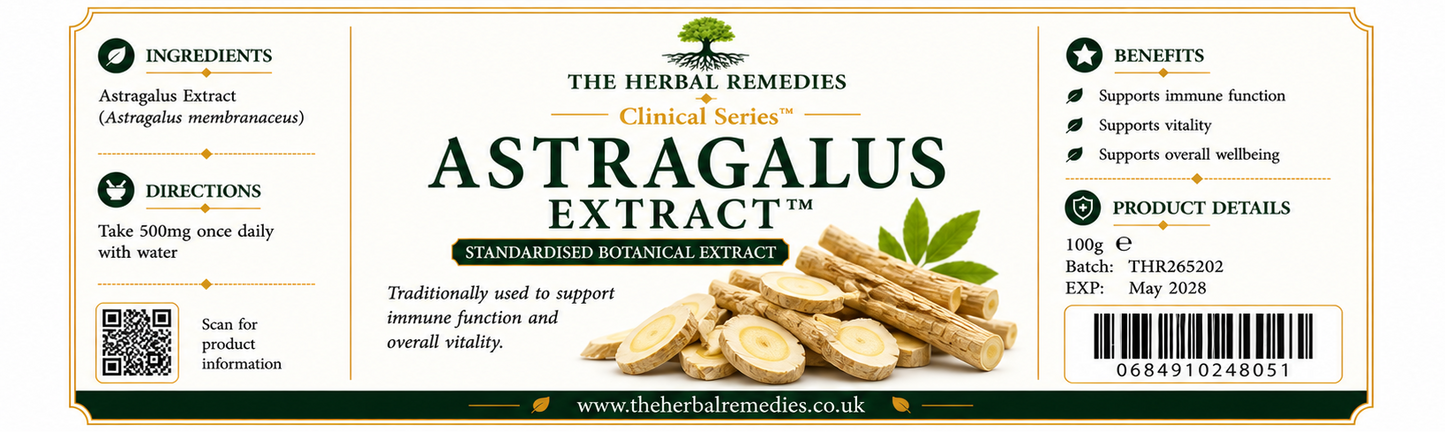
Astragalus Extract (Astragalus membranaceus) 10:1- Natural Immunity & Vitality Support
Astragalus Extract (Astragalus membranaceus) 10:1- Natural Immunity & Vitality Support
Couldn't load pickup availability
Astragalus Extract 10:1 – The Premier Adaptogen of Traditional Chinese Medicine
Astragalus (Astragalus membranaceus), known in Traditional Chinese Medicine (TCM) as Huang Qi (黄訊), is one of the most extensively researched adaptogenic herbs in integrative and functional medicine. Used for over 2,000 years as a foundational Qi-tonifying herb, Astragalus has accumulated a substantial body of peer-reviewed clinical evidence supporting its role in immune modulation, renal protection, telomere biology, and stress resilience. Our 10:1 concentrated extract delivers the equivalent of 10g of raw Astragalus root per gram of extract, ensuring maximum bioactive potency in every serving.
- 10:1 concentrated Astragalus membranaceus root extract
- Rich in Astragalosides, Cycloastragenol, polysaccharides & flavonoids
- Available in 50g & 100g resealable packs
- 100% pure • Vegan • No fillers or additives
- Suitable for teas, decoctions, smoothies & capsule blends
Key Compounds & Clinical Evidence
- Astragaloside IV (Triterpenoid Saponin) — The principal bioactive compound in Astragalus root, Astragaloside IV is the most studied constituent for both immunomodulatory and nephroprotective activity. A clinical study published in the American Journal of Nephrology (2014) demonstrated that Astragaloside IV supplementation significantly reduced proteinuria and serum creatinine levels in patients with chronic kidney disease (CKD), while improving glomerular filtration rate (GFR) — indicating measurable renal protective effects. Its mechanism involves suppression of TGF-β1-mediated renal fibrosis and reduction of oxidative stress in tubular epithelial cells.
- Cycloastragenol (Telomerase Activator) — A sapogenin derived from Astragaloside IV, Cycloastragenol is one of the few naturally occurring compounds demonstrated to activate telomerase — the enzyme responsible for maintaining telomere length. A landmark study published in Rejuvenation Research (2011) by the TA Sciences group found that Cycloastragenol (TA-65) supplementation measurably increased telomere length in immune cells and reduced the proportion of critically short telomeres in ageing subjects, representing a direct molecular mechanism for anti-ageing activity. Telomere attrition is a primary hallmark of cellular ageing (Cell, 2013).
- Astragalus Polysaccharides (APS) — A complex of heteropolysaccharides that function as potent biological response modifiers (BRMs). Multiple randomised controlled trials have demonstrated APS's immunomodulatory activity, including a meta-analysis in the Journal of Ethnopharmacology (2016) covering 34 clinical studies, which confirmed APS significantly enhanced natural killer (NK) cell activity, T-lymphocyte proliferation, and macrophage phagocytosis — key pillars of innate and adaptive immune defence. APS also demonstrated adjuvant activity in cancer immunotherapy protocols, enhancing the efficacy of chemotherapy while reducing immunosuppressive side effects.
- Formononetin & Calycosin (Isoflavonoids) — These phytoestrogenic flavonoids contribute to Astragalus's nephroprotective and anti-inflammatory profile. Research in the Journal of Ethnopharmacology (2013) demonstrated that Calycosin inhibited NF-κB-mediated inflammatory signalling in renal mesangial cells, reducing glomerular inflammation — a key pathological driver in diabetic nephropathy and IgA nephropathy. Formononetin has additionally been shown to promote renal tubular cell regeneration following ischaemic injury.
- Astragalus Saponins (Immunomodulation & Adaptogenic Activity) — Beyond Astragaloside IV, the broader saponin fraction of Astragalus modulates the hypothalamic-pituitary-adrenal (HPA) axis, reducing cortisol dysregulation under chronic stress. A double-blind, placebo-controlled trial in Phytomedicine (2010) confirmed Astragalus extract's adaptogenic effects, demonstrating significant reductions in fatigue scores, improved physical endurance, and enhanced recovery from exercise-induced stress in healthy adults over 8 weeks.
- Astragalus Flavonoids (Antioxidant & Cardioprotective) — The flavonoid fraction — including quercetin, kaempferol, and isorhamnetin glycosides — provides broad-spectrum antioxidant protection, neutralising reactive oxygen species (ROS) and reducing lipid peroxidation. A review in Oxidative Medicine and Cellular Longevity (2017) highlighted Astragalus flavonoids' cardioprotective effects, including endothelial protection, reduction of LDL oxidation, and support for healthy blood pressure regulation.
Clinical Focus: Kidney Health
Astragalus has one of the strongest evidence bases among herbal medicines for renal support. Key mechanisms include:
- Anti-fibrotic action — Astragaloside IV inhibits TGF-β1 signalling, the primary driver of renal fibrosis in CKD progression (Nephrology Dialysis Transplantation, 2012)
- Reduction of proteinuria — Multiple clinical trials confirm significant reductions in urinary protein excretion in CKD and diabetic nephropathy patients (American Journal of Nephrology, 2014)
- Glomerular protection — APS and Calycosin reduce glomerular inflammation and mesangial cell proliferation, protecting filtration integrity
- Oxidative stress reduction — Astragalus extracts significantly reduce malondialdehyde (MDA) and increase superoxide dismutase (SOD) activity in renal tissue (Journal of Ethnopharmacology, 2015)
- Adjunct to dialysis — A systematic review in Evidence-Based Complementary and Alternative Medicine (2013) found Astragalus injection and oral supplementation improved quality of life and reduced anaemia markers in haemodialysis patients
Traditional TCM Context
In TCM, Astragalus (Huang Qi) is classified as a superior Qi tonic that strengthens Wei Qi (defensive energy), tonifies the Spleen and Lung meridians, and promotes fluid metabolism — directly corresponding to its modern evidence base in immune defence, respiratory support, and renal fluid regulation. It is a cornerstone of classical formulas including Yu Ping Feng San (Jade Windscreen Formula) for immune resilience.
How to Use
Mix ½ teaspoon (≈1g) daily into warm water, herbal tea, broth, or a smoothie. For renal or therapeutic support, consult a qualified TCM practitioner or integrative medicine professional for personalised dosing. Use consistently for a minimum of 8 weeks for best results.
Food supplement only. Not intended to diagnose, treat, cure, or prevent any disease. Consult a healthcare professional before use if pregnant, breastfeeding, taking immunosuppressants, or managing a kidney condition. Keep out of reach of children.
Share