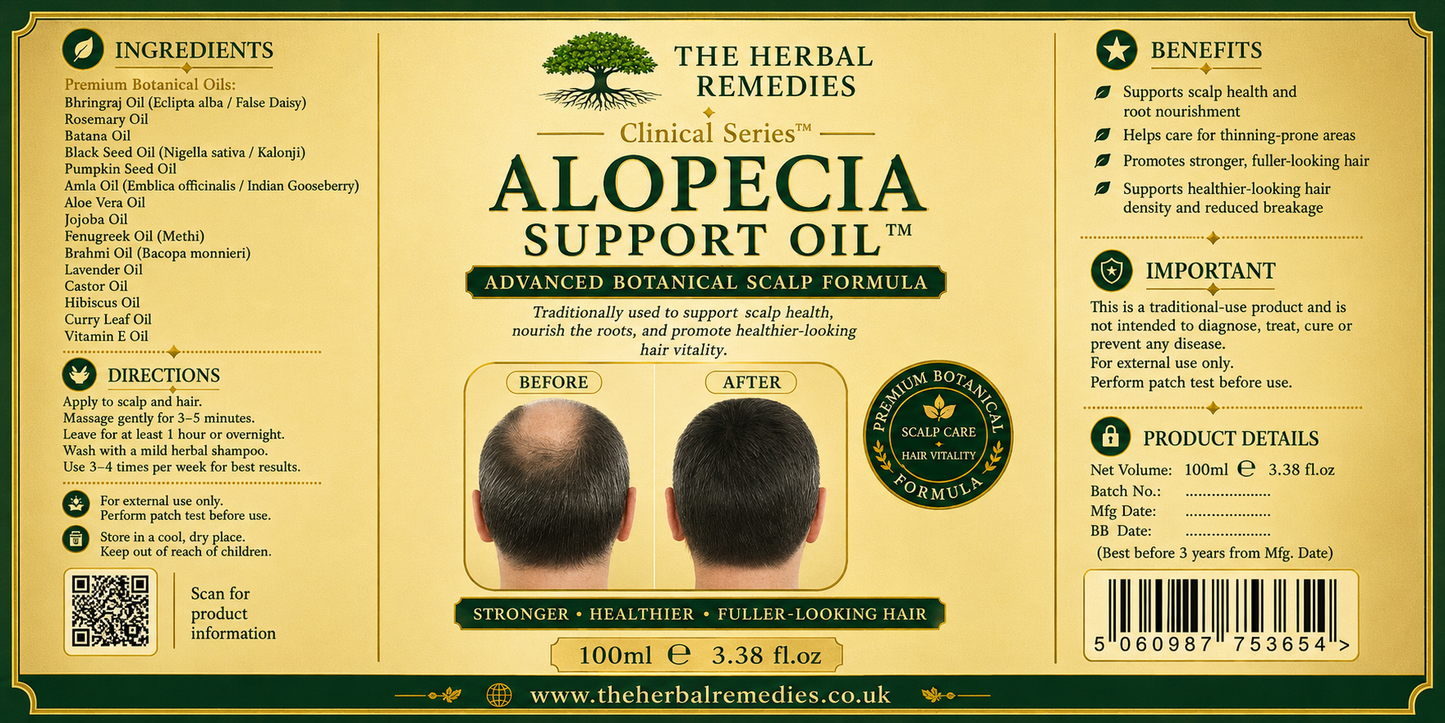
Alopecia Hair Oil — Clinical Regrowth & Anti-Hair Fall Formula
Alopecia Hair Oil — Clinical Regrowth & Anti-Hair Fall Formula
Couldn't load pickup availability
Alopecia Hair Oil — Clinical Regrowth & Anti-Hair Fall Formula
A precision-blended Ayurvedic and Unani hair oil formulated to address the root causes of hair thinning, alopecia, and scalp imbalance. Each 100ml bottle combines time-honoured botanical extracts with ingredients validated by contemporary clinical research, delivering a multi-action treatment for visible regrowth and sustained follicular health.
Ingredients
- Pure Almond Oil (Prunus dulcis)
- Rosemary Oil (Rosmarinus officinalis)
- Roghan Baiza Murgh (Egg Yolk Oil)
- Roghan Zarareen (Saffron-infused Oil)
- Brahmi Oil (Bacopa monnieri)
- Hibiscus Oil (Hibiscus rosa-sinensis)
- Curry Leaf Oil (Murraya koenigii)
- Jojoba Oil (Simmondsia chinensis)
- Jatamansi Oil (Nardostachys jatamansi)
- Aloe Vera Oil (Aloe barbadensis)
- Neem Oil (Azadirachta indica)
Benefits & Clinical Research
1. Stimulates Hair Regrowth
Rosemary oil is the most clinically substantiated ingredient in this formula. A landmark randomised controlled trial published in SKINmed Journal (Panahi et al., 2015) demonstrated that 2% rosemary oil applied topically over 6 months produced hair count increases comparable to 2% minoxidil, with significantly less scalp itching. The active compound rosmarinic acid inhibits 5α-reductase, reducing DHT-mediated follicular miniaturisation — a primary driver of androgenetic alopecia.
2. Reduces Hair Fall & Strengthens Follicles
Brahmi (Bacopa monnieri) has been shown in preclinical studies to increase hair shaft diameter and stimulate follicular proliferation via the Wnt/β-catenin signalling pathway (Sharma et al., Journal of Ethnopharmacology, 2012). Jatamansi (Nardostachys jatamansi) demonstrated significant anti-alopecia activity in a 2011 study (Phytotherapy Research), promoting anagen phase prolongation and reducing telogen effluvium markers.
3. Deep Scalp Nourishment & Moisture Retention
Almond oil is rich in oleic acid (70%) and linoleic acid, which penetrate the hair cortex to reduce protein loss. A study in the Journal of Cosmetic Science (Rele & Mohile, 2003) confirmed that oils high in triglycerides significantly reduce hygral fatigue and hair breakage. Jojoba oil — structurally similar to human sebum — regulates scalp sebum production and maintains the lipid barrier, as noted in International Journal of Molecular Sciences (2019).
4. Anti-Inflammatory & Scalp Microbiome Support
Neem oil contains nimbidin and azadirachtin, compounds with well-documented antifungal and anti-inflammatory properties. A review in Evidence-Based Complementary and Alternative Medicine (2013) confirmed neem's efficacy against Malassezia species — a key contributor to seborrhoeic dermatitis and secondary hair loss. Aloe vera oil delivers acemannan polysaccharides that soothe scalp inflammation and support keratinocyte regeneration.
5. Follicular Nutrition via Roghan Baiza Murgh (Egg Yolk Oil)
Egg yolk oil is a concentrated source of phospholipids, lecithin, and fat-soluble vitamins (A, D, E, K). A 2018 study in Archives of Dermatological Research found that topical phospholipid application improved hair density and tensile strength by reinforcing the lipid envelope of the hair shaft. In Unani medicine, Roghan Baiza Murgh is a classical Muqawwi Sha'r (hair fortifier) with centuries of documented use.
6. Scalp Circulation & DHT Inhibition via Hibiscus & Curry Leaf
Hibiscus (Hibiscus rosa-sinensis) leaf and flower extracts were shown in a study published in the Journal of Ethnopharmacology (2003) to significantly increase hair length and follicle count in animal models, with activity attributed to flavonoids promoting anagen induction. Curry leaf (Murraya koenigii) is rich in carbazole alkaloids that exhibit antioxidant activity, protecting follicles from oxidative stress-induced premature shedding.
7. Saffron (Roghan Zarareen) — Antioxidant & Mood-Linked Hair Health
Saffron contains crocin and safranal, potent antioxidants that neutralise free radical damage at the follicular level. Emerging research (Phytomedicine, 2021) links saffron's anti-cortisol properties to reduced stress-induced telogen effluvium, addressing a frequently overlooked trigger of diffuse hair loss.
How to Use
- Apply 5–10 drops directly to the scalp and parted sections of hair.
- Massage gently in circular motions for 5–10 minutes to stimulate circulation.
- Leave on for a minimum of 2 hours or overnight for intensive treatment.
- Wash out with a mild, sulphate-free shampoo.
- Use 3–4 times per week for optimal results. Consistent use over 8–12 weeks is recommended for visible regrowth.
Disclaimer: This product is formulated using traditional Ayurvedic and Unani principles supported by available clinical literature. It is not intended to diagnose, treat, cure, or prevent any medical condition. Results may vary. Consult a qualified healthcare practitioner if you have a diagnosed scalp or hair disorder.
Share