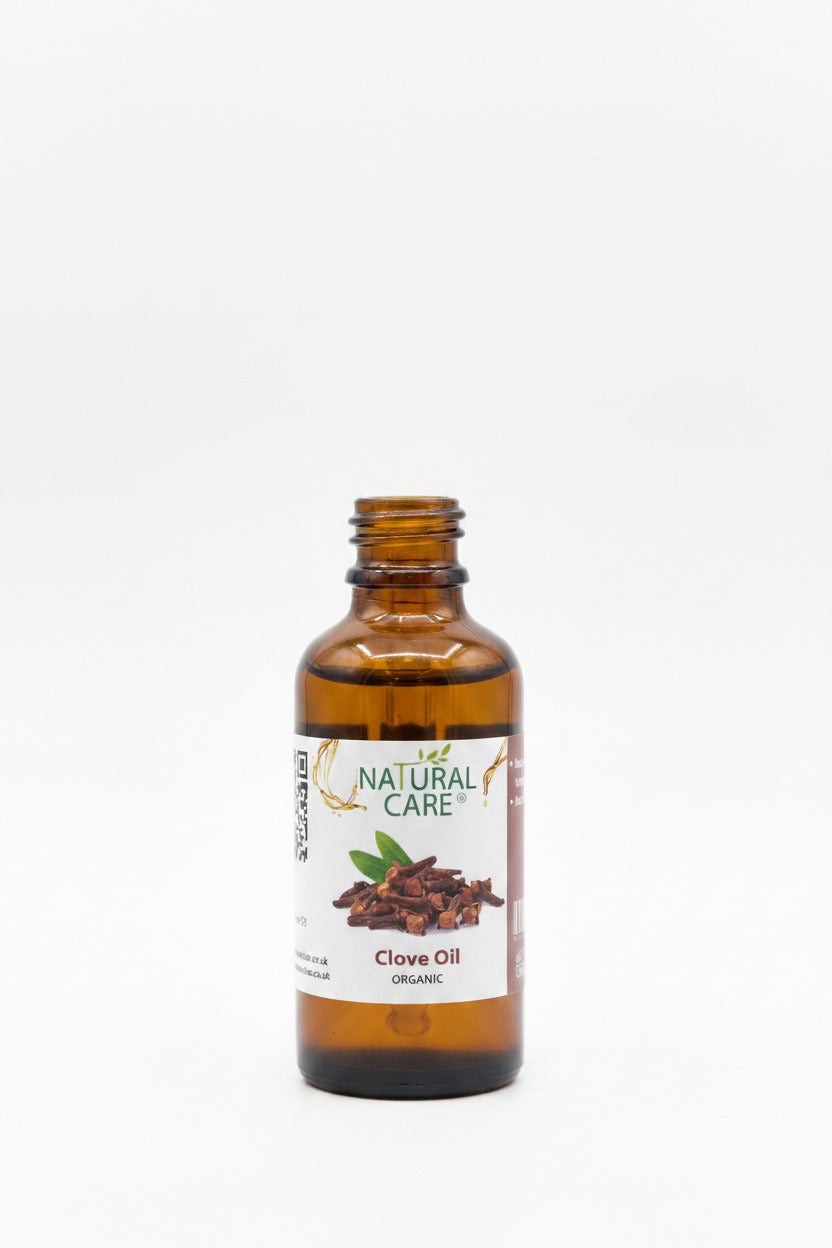
Clove Oil — Organic Essential Oil (Syzygium aromaticum)
Clove Oil — Organic Essential Oil (Syzygium aromaticum)
Couldn't load pickup availability
Clove Oil — Organic Essential Oil
Syzygium aromaticum · Eugenia caryophyllata · Clove Bud Oil
One of the most potent and extensively studied essential oils in botanical medicine, Clove Oil has been used for over 2,000 years across Ayurvedic, Chinese, and European herbal traditions. Steam-distilled from the dried flower buds of Syzygium aromaticum, our certified organic oil delivers an exceptionally high concentration of eugenol — the primary bioactive phenylpropanoid responsible for clove’s characteristic warm, spicy aroma and its remarkable range of clinically documented properties.
*This product is an essential oil for aromatherapy and external use only. It is not intended to diagnose, treat, cure, or prevent any disease. Always consult a qualified healthcare professional before use. Not for internal consumption.
🌿 Ingredients
- 100% Pure Organic Syzygium aromaticum Bud Oil — steam-distilled, unblended, no synthetic additives
- Key naturally occurring compounds: Eugenol (70–90%), Eugenyl acetate (5–15%), β-Caryophyllene (5–12%), α-Humulene, Chavicol, Methyl eugenol, α-Pinene, Vanillin
Certified Organic · No synthetic fragrance · No carriers · Vegan · Non-GMO
✅ Clinical Benefits
🦠 Antimicrobial & Antibacterial Activity
Eugenol is one of the most well-characterised natural antimicrobial agents in phytochemistry. A comprehensive review in Phytotherapy Research (Devi et al., 2010) confirmed broad-spectrum antibacterial activity of clove oil against Staphylococcus aureus, Escherichia coli, Salmonella typhi, and Pseudomonas aeruginosa, with minimum inhibitory concentrations (MICs) comparable to standard antibiotics. A further study in Journal of Applied Microbiology (Chaieb et al., 2007) demonstrated eugenol’s ability to disrupt bacterial cell membrane integrity and inhibit biofilm formation — a key mechanism of antibiotic resistance.
🔥 Anti-Inflammatory Action
Eugenol is a potent inhibitor of cyclooxygenase (COX-1 and COX-2) enzymes — the same pathway targeted by NSAIDs. A study in Journal of Dental Research (Markowitz et al., 1992) confirmed eugenol’s anti-inflammatory efficacy in oral tissues. A more recent study in Molecules (Bachiega et al., 2012) demonstrated significant suppression of pro-inflammatory cytokines (TNF-α, IL-1β, IL-6) by eugenol in macrophage models, supporting its use in inflammatory conditions. β-Caryophyllene, a secondary constituent, acts as a selective CB2 receptor agonist, providing additional anti-inflammatory activity via the endocannabinoid system (Gertsch et al., PNAS, 2008).
🛡 Antifungal Properties
Multiple studies have confirmed clove oil’s potent antifungal activity. A study in Oral Microbiology and Immunology (Pinto et al., 2009) found clove essential oil highly effective against Candida albicans, Candida tropicalis, and Candida krusei, including fluconazole-resistant strains. A further study in Mycopathologia (Arora & Bhowmik, 2008) confirmed activity against dermatophytes including Trichophyton rubrum and Microsporum canis, supporting topical use in fungal skin conditions when appropriately diluted.
🧠 Analgesic & Numbing Properties (Topical)
Eugenol’s analgesic mechanism involves blockade of voltage-gated sodium channels and inhibition of substance P release. A randomised controlled trial (Alqareer et al., Journal of Dentistry, 2006) found topical clove gel equivalent to benzocaine 20% gel in reducing needle insertion pain — the gold standard topical anaesthetic in clinical dentistry. This supports its traditional use in diluted topical applications for localised discomfort.
❤️ Cardiovascular & Antioxidant Activity
Clove oil demonstrates exceptionally high antioxidant capacity. A study in Food Chemistry (Gulçin et al., 2012) ranked clove among the highest ORAC (Oxygen Radical Absorbance Capacity) scoring botanicals tested, with eugenol showing potent DPPH and ABTS radical scavenging activity. A study in Thrombosis Research (Srivastava, 1993) found eugenol inhibited platelet aggregation in a dose-dependent manner, suggesting cardiovascular-protective properties relevant to aromatherapy and massage applications.
🌬 Respiratory Aromatherapy Support
Clove oil’s expectorant and mucolytic properties have been documented in traditional medicine systems and supported by in vitro evidence. Its use in steam inhalation blends for upper respiratory congestion is recognised by the European Medicines Agency (EMA) under traditional herbal use provisions. β-Caryophyllene has additionally demonstrated bronchodilatory effects in animal models (Boskabady et al., Phytomedicine, 2013), supporting clove’s role in respiratory aromatherapy blends.
✨ Skin & Topical Applications
When appropriately diluted (maximum 0.5% for leave-on skin products per IFRA guidelines), clove oil’s antimicrobial and anti-inflammatory properties support use in acne-prone skin formulations. A study in Journal of Cosmetic Dermatology (Thosar et al., 2013) confirmed eugenol’s efficacy against Propionibacterium acnes (now Cutibacterium acnes). Its warming, circulatory-stimulating properties also make it a valued component in massage blends for muscular tension and joint discomfort.
🌺 Insect Repellent Activity
A study in Phytotherapy Research (Trongtokit et al., 2005) found clove oil to be one of the most effective plant-based mosquito repellents tested, providing up to 2–4 hours of complete protection against Aedes aegypti at 100% concentration, with eugenol identified as the primary active constituent. This supports its use in natural insect-repellent diffuser and topical blends (when diluted).
💧 How to Use
Aromatherapy (Diffuser)
- Add 1–2 drops to a water-filled diffuser (clove is potent — use sparingly)
- Blends well with: Orange, Cinnamon, Frankincense, Cedarwood, Ginger, Ylang Ylang
Topical (Massage & Skin)
- Dilute to a maximum of 0.5% in a carrier oil for leave-on skin use (1 drop per 10ml carrier)
- For massage blends: 1–2 drops per 10ml carrier oil
- Always patch test on inner arm 24 hours before first use — clove oil is a known skin sensitiser at higher concentrations
Steam Inhalation
- Add 1 drop to a bowl of hot (not boiling) water; drape a towel over head and inhale for 5–10 minutes
- Keep eyes closed during inhalation
⚠️ Safety & Compliance
- For external and aromatherapy use only — do not ingest
- Always dilute before skin application — do not apply neat; clove oil is a potent skin sensitiser
- Maximum dermal use level: 0.5% (leave-on) per IFRA guidelines
- Avoid contact with eyes and mucous membranes
- Not recommended during pregnancy or breastfeeding without medical supervision
- Avoid use on children under 2 years; use with caution in older children
- May interact with anticoagulant medications — consult a healthcare professional
- Keep out of reach of children
- Store in a cool, dark place in original amber glass bottle
📚 Key Clinical References
- Devi K.P. et al. (2010). Phytotherapy Research — Broad-spectrum antibacterial activity of clove oil
- Chaieb K. et al. (2007). Journal of Applied Microbiology — Eugenol: membrane disruption & biofilm inhibition
- Gertsch J. et al. (2008). PNAS — β-Caryophyllene as selective CB2 receptor agonist
- Alqareer A. et al. (2006). Journal of Dentistry — RCT: clove gel vs benzocaine for topical analgesia
- Pinto E. et al. (2009). Oral Microbiology and Immunology — Antifungal activity against Candida spp.
- Bachiega T.F. et al. (2012). Molecules — Eugenol & cytokine suppression in macrophage models
- Gulçin I. et al. (2012). Food Chemistry — Antioxidant capacity of eugenol (ORAC/DPPH/ABTS)
- Trongtokit Y. et al. (2005). Phytotherapy Research — Clove oil as mosquito repellent
- Boskabady M.H. et al. (2013). Phytomedicine — Bronchodilatory effects of β-Caryophyllene
- Srivastava K.C. (1993). Thrombosis Research — Eugenol & platelet aggregation inhibition
Share